Tractor unit with hydraulics: who needs it and how to choose
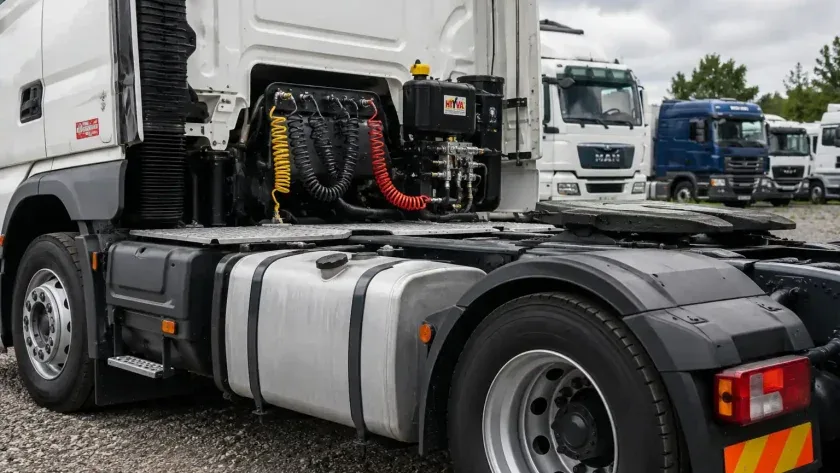
Hydraulics on a tractor unit are needed for trailers with hydraulic drive: tippers, moving floors, certain tankers, and special trailers. A mistake in choosing the system after purchase turns into reworking the connection, replacing hoses, the pump, the tank, or a full hydraulic retrofit.
In the tirkomis catalog of tractor units, such machines have a separate "Hydraulics" filter. After filtering, you need to check which trailer the system worked with, which components are installed, and whether it matches your future task.
When hydraulics are needed
A hydraulic system is needed when the trailer performs work through a hydraulic drive. The main scenarios are lifting a tipper body, operating a moving floor, pumping or servicing certain tankers, and operating special equipment.
For a tipper trailer, hydraulics are responsible for lifting the body during unloading. For a moving floor, pump output, working pressure, tank volume, and the number of circuits matter. For tankers and special trailers, the parameters depend on the specific equipment.
| Task | Is hydraulics needed | What to check |
|---|---|---|
| Tipper trailer | Yes | PTO, pump, tank, pressure, connection |
| Moving floor | Yes | Pump output, circuits, tank volume |
| Tanker | Depends on the equipment | Connection type, pressure, compatibility |
| Curtainsider or standard refrigerator | Usually not | Hydraulics is not mandatory |
| Special trailer | Depends on the task | Equipment operating scheme and manufacturer requirements |
Before browsing listings, you need to determine the type of trailer. This narrows the search and helps immediately filter out tractor units with an unsuitable configuration.
What the tractor unit's hydraulic system consists of
A tractor unit's hydraulic system consists of several main components. Each affects how it works with the trailer, so during inspection you check more than just the tank behind the cab.
PTO — power take-off. It transfers drive from the transmission to the hydraulic pump. Without a working PTO, the pump cannot create the required pressure in the system.
The pump supplies oil under pressure. Different output parameters are needed for a tipper, a moving floor, and special equipment.
The tank stores hydraulic oil. Its volume must match the task. A too-small tank or improper mounting can cause overheating, oil shortage, and unstable system operation.
Hoses, valves, and fittings are responsible for oil supply, tightness, and flow control. Cracks, leaks, weak connections, or poorly matched hoses create a risk of failure under load.
Circuits determine the system's functionality. For a tipper trailer, a simpler solution is often enough. For a moving floor, tankers, or more complex equipment, you need to check the number of circuits, pressure, and output.
Hyva describes how a PTO works in its PTO Installation section: "The PTO transfers drive from the gearbox to hydraulic pumps, compressors, and other auxiliary equipment." On a used tractor unit, the PTO must be checked in operation, not just from the catalog description.
Compatibility with the trailer: what to verify before buying
A "hydraulics" tag in a listing does not confirm compatibility with a specific trailer. A system that worked with a tipper may need rework for a moving floor, tanker, or other special trailer.
Before putting down a deposit, you need to check:
- which trailer the hydraulics worked with;
- which pump is installed;
- the system's working pressure;
- the pump's output;
- the tank volume;
- how many circuits the system has;
- the type of connection to the trailer;
- whether the connections match the future trailer;
- whether there are leaks, noise, overheating, or delays in operation.
If the system doesn't fit, after purchase you'll have to replace hoses, the pump, the tank, valves, or the connection scheme. These costs need to be calculated before signing the deal, not after the first load.
Hydraulic retrofit: when it makes sense to install after purchase
Installing hydraulics after purchase makes sense when the tractor unit itself has a strong base: a sound frame, gearbox, engine, electrics, sufficient power, a suitable axle configuration, and space for mounting the tank. If the machine needs repairs to major components, a hydraulic retrofit will increase the starting budget and delay getting to work.
The benchmark for installation is from $1,500+. The final amount depends on the type of hydraulics, the number of circuits, the pump, the tank, hoses, valves, mounting, and the task: tipper, moving floor, tanker, or other equipment.
tirkomis can help with selecting a tractor unit and fitting hydraulics after purchase. This is relevant when the catalog has a technically strong option without the required configuration.
Hydraulics, ADR, and lift axle: different parameters in the catalog
In the tractor unit catalog, hydraulics, ADR, and lift axle cover different tasks. They need to be checked separately.
Hydraulics are needed for working with the trailer's equipment: a tipper body, a moving floor, a tanker, or a special trailer.
ADR is needed for transporting dangerous goods: fuel, chemicals, gases, and other categories. For such tasks, you check technical condition, documents, approvals, and compliance with the type of transport. More on this in the article ADR tractor unit: documents, equipment, and prices on the secondary market.
Lift axle affects load distribution, tire wear, and operation with different combination weights. It does not replace hydraulics and does not confirm the tractor unit's suitability for a tipper trailer.
For a tipper, the main filter is "Hydraulics." For fuel or chemicals — ADR. For tasks with varying combination weight — lift axle.
Tractor units with hydraulics in the tirkomis catalog: budgets and examples
Tractor units with hydraulics should be compared across three parameters: task, budget, technical condition. The brand matters, but the final decision depends on the trailer, the hydraulics parameters, and the budget for initial servicing.
The prices below are a benchmark based on offers in the tirkomis catalog. Current availability, the machine's status, and the final price need to be checked in the catalog or with a manager.
Budget benchmark
| Budget | Examples from the catalog | Selection logic |
|---|---|---|
| Up to $10,000 | MAN TGA 18.460, MAN TGA 26.410 | Lower budget, older equipment, mandatory check of hydraulics and basic components |
| $10,000–15,000 | DAF XF 105.510, DAF CF 85.410 | Working segment for tippers, agriculture, or simpler tasks |
| $20,000–35,000 | Renault T 440, Volvo FH 16.610 | Newer model, stronger configuration, higher power or VAT |
| $40,000+ | Volvo FH 13.500 | More expensive segment for heavier tasks and a bigger remaining service life |
Up to $10,000: MAN TGA
MAN TGA 18.460 with hydraulics costs around $6,000, and MAN TGA 26.410 — around $8,000. This is the lower budget for a buyer ready to carefully inspect older equipment.
At inspection, you need to go through the engine, gearbox, frame, electrics, tires, PTO, pump, tank, and hoses. A MAN TGA makes sense only when the technical condition doesn't eat up the budget right after purchase.
$10,000–15,000: DAF XF and DAF CF
DAF XF 105.510 at around $11,999 and DAF CF 85.410 at around $13,000 — the mid working segment.
These DAFs are considered for a tipper trailer, agriculture, or regional work, when you need 410–510 hp, a straightforward design, and hydraulics already installed. Before buying, you need to check the system against the future trailer.
$20,000–35,000: Renault T and Volvo FH
Renault T 440 with hydraulics costs around $25,500. This is an option for a buyer looking for a more modern model, an automatic gearbox, lower mileage compared to older tractor units, and better readiness for daily work.
Volvo FH 16.610 at around $32,500 with VAT is a more expensive option in the same range. It's considered for heavier tasks that require power, 6×4, VAT, or a stronger configuration.
$40,000+: Volvo FH 13.500
Volvo FH 13.500 at around $44,000 is the top budget among the examples in this article. Such a tractor unit is considered when you need more remaining service life, power, and readiness for stable work with a heavier trailer.
In this segment, it's important to evaluate not just the hydraulics but the overall condition of the machine: mileage, gearbox, engine, axle, frame, electronics, VAT, and documents.
Choosing between MAN, DAF, Renault, and Volvo
Short selection logic: MAN TGA — lower budget, DAF — mid working segment, Renault T — more modern model, Volvo FH — more expensive option for heavier tasks. The final decision is made after checking the hydraulics, basic components, documents, and compatibility with the trailer.
For a broader breakdown of power, axle configuration, Euro class, and other parameters, see the article How to choose a tractor unit by specifications: breaking down the parameters.
How to find a tractor unit with hydraulics in the tirkomis catalog
Open the tirkomis catalog of tractor units and select the "Hydraulics" filter. After that, narrow the search by brand, year, price, gearbox, power, drive, ADR, lift axle, and location.
For an accurate selection, prepare the basic data:
- trailer type;
- budget;
- desired brand;
- year;
- power;
- gearbox;
- VAT;
- hydraulics requirements;
- need for ADR or a lift axle.
With this data, a manager can quickly orient you on available tractor units, the equipment's status, inspection options, and further fitting. If there's no ready-made option in the catalog, you can select a tractor unit for a hydraulic retrofit.
tirkomis can help with selecting a tractor unit, checking the equipment, arranging the deal, and fitting hydraulics after purchase. For the buyer, this reduces the risk of buying a machine that doesn't fit the future trailer.
Before putting down a deposit, it's worth doing a technical inspection. If time is short, a basic algorithm from the article How to check a used truck in 30 minutes will help. At the paperwork stage, you check the documents, the owner, the VIN, restrictions, VAT, and whether the data matches the actual equipment. More details in the article Buying commercial equipment: which documents to check.
Frequently asked questions
Why is hydraulics needed on a tractor unit?
Hydraulics are needed for working with trailers that have hydraulic equipment: a tipper body, a moving floor, a tanker, or special mechanisms.
What is a hydraulic retrofit on a tractor unit?
A hydraulic retrofit is the installation of a hydraulic system. It usually includes a PTO, a pump, a tank, hoses, valves, fittings, controls, and a connection matched to a specific trailer.
What is a PTO on a tractor unit?
A PTO is a power take-off. It transfers mechanical energy from the gearbox to the hydraulic pump, which creates pressure in the system.
How much does it cost to install hydraulics on a tractor unit?
Installing hydraulics costs roughly from $1,500+. The exact price depends on the type of system, the pump, the tank, the number of circuits, hoses, mounting, and the task.
Will hydraulics from a tipper work for a moving floor?
Not always. A moving floor may have different requirements for pump output, pressure, tank volume, number of circuits, and connection type.
What's better: buying a tractor unit with hydraulics already installed, or fitting it separately?
A ready-made tractor unit with hydraulics gets to work faster. Installing it separately makes sense if the machine itself is a good deal and is technically suited to a retrofit.
How much does a tractor unit with hydraulics cost?
In the tirkomis catalog you can find older tractor units with hydraulics from roughly $6,000–8,000, DAF units around $12,000–13,000, Renault T around $25,500, and Volvo FH in the more expensive segment from $32,500 to $44,000.
Which brands of tractor units with hydraulics are worth looking at?
MAN, DAF, Renault, and Volvo are compared most often. MAN TGA — lower budget, DAF — mid working segment, Renault T — more modern model, Volvo FH — more expensive option for heavier tasks.
What should be checked in the hydraulics before buying?
Check the PTO, pump, tank, oil, hoses, fittings, valves, controls, leaks, noise, pressure, mounting quality, and compatibility with the trailer.
How do I find a tractor unit with hydraulics at tirkomis?
Open the tirkomis catalog of tractor units and use the "Hydraulics" filter. Then narrow the search by brand, year, price, gearbox, power, drive, ADR, and lift axle.
Related articles

Semi-trailer bag: what to do with it after purchase
How to use or convert a semi-trailer bag. Inspection, documents and prices. TIRkomis - free parking and advertising for sale.

How to choose a container chassis: 20, 40, 45
How to choose a container chassis for 20, 40, and 45-foot containers? We'll break down frame types, container locks, axle loads, compatibility with the tractor unit, and how to inspect a used chassis before buying.

Truck unit diagnostics before purchase: which faults are critical
We explain how to read a ttruckunit computer diagnostic report, which engine, transmission, EBS, AdBlue and DPF faults are critical, and when a malfunction is grounds for justified negotiation.