How to choose a tractor unit by specifications: breaking down the parameters
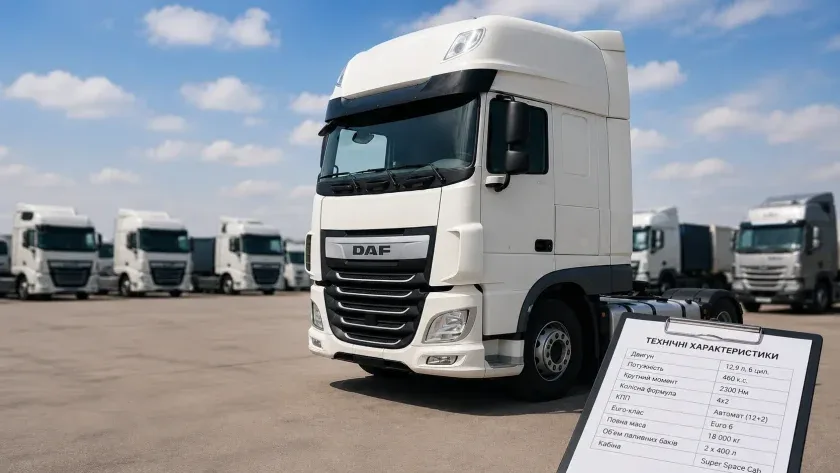
When you open a listing for a MAN TGX, DAF XF, Volvo FH, Scania R, Mercedes-Benz Actros, or Renault T, the first thing worth reading is not just the price and year. The model name often already contains clues: the tractor unit's class, power, chassis type, or purpose. But these numbers only make sense when compared against practice: routes, cargo, combination weight, and fuel consumption.
Where to start reading the specifications
The model name helps you get oriented quickly, but it doesn't replace a full inspection. In a MAN TGX 18.440, the number "18" usually indicates the tractor unit's weight class, and "440" indicates engine power. In a Renault T 460 or Volvo FH 500, the numbers are mostly tied to horsepower. But the labeling logic differs between brands: in the official Volvo FH specifications, it's important to check the engine version, while for the MAN TGX, you also need to check the chassis, cabin, and trim level. So the badge on the cab should be treated as a clue, and the final data should be verified against the documents, VIN, and technical condition.
Power, axle configuration, and what else affects the choice
For standard European routes, 420–460 hp is often enough. Such a tractor unit can be more economical and cheaper to maintain. Power of 500+ hp is appropriate for heavier routes, mountainous terrain, tankers, or work at maximum combination weight. At the same time, horsepower isn't the only thing that matters — torque matters too: DAF XF materials emphasize pulling power at low revs, because it affects economy and how the tractor unit behaves under load.
The axle configuration also needs to match the job. 4×2 is the most common option for long-haul transport, 6×2 distributes load better, and 6×4 is needed where traction matters more than economy. If the choice between configurations isn't obvious, it's better to evaluate the difference between 4x2, 6x2, and 6x4 for a tractor unit against your specific routes and cargo.
It's also worth checking the Euro class, gearbox, retarder, and cabin separately. Euro 5 or Euro 6 affects access to international routes, servicing, taxes, and the tractor unit's future resale. An automated gearbox is convenient on long routes, and a retarder reduces the load on the brakes on descents. The cabin isn't secondary either: for international routes, the sleeping berth, an independent heater, tank volume, and driver comfort all matter.
| Parameter | How to read it |
|---|---|
| Power | 420–460 hp is the baseline for European routes; 500+ hp is for heavier conditions. |
| Torque | Shows how the tractor unit pulls at low revs and under load. |
| Axle configuration | 4×2 for highway, 6×2 for heavier loads, 6×4 for tougher conditions. |
| Euro class | Affects routes, taxes, servicing, and resale value. |
| Cabin | For international routes, an independent heater, sleeping berth, tanks, and comfort matter. |
How specifications affect the price
On the secondary market, a tractor unit's price doesn't depend on the brand alone. Year, Euro class, power, axle configuration, gearbox, mileage, cabin, retarder, and overall condition all matter. In the tirkomis catalog you can find older Volvo FH units from around $5,500–16,000, Renault Magnum around $15,000, DAF XF around $14,200, while newer or better-equipped tractor units cost significantly more. To compare models for international routes, the top 5 tractor units for European routes roundup is useful, covering popular options from a carrier's perspective.
The advantage of consignment sale of commercial equipment is that a tractor unit can be evaluated not just by the badge on the cab, but by its condition, configuration, and intended use. Check out current listings in the tirkomis catalog, and follow new arrivals on our Telegram channel.
Related articles

Semi-trailer bag: what to do with it after purchase
How to use or convert a semi-trailer bag. Inspection, documents and prices. TIRkomis - free parking and advertising for sale.

How to choose a container chassis: 20, 40, 45
How to choose a container chassis for 20, 40, and 45-foot containers? We'll break down frame types, container locks, axle loads, compatibility with the tractor unit, and how to inspect a used chassis before buying.

Truck unit diagnostics before purchase: which faults are critical
We explain how to read a ttruckunit computer diagnostic report, which engine, transmission, EBS, AdBlue and DPF faults are critical, and when a malfunction is grounds for justified negotiation.