Euro 5 and Euro 6: Restrictions for Carriers in 2026
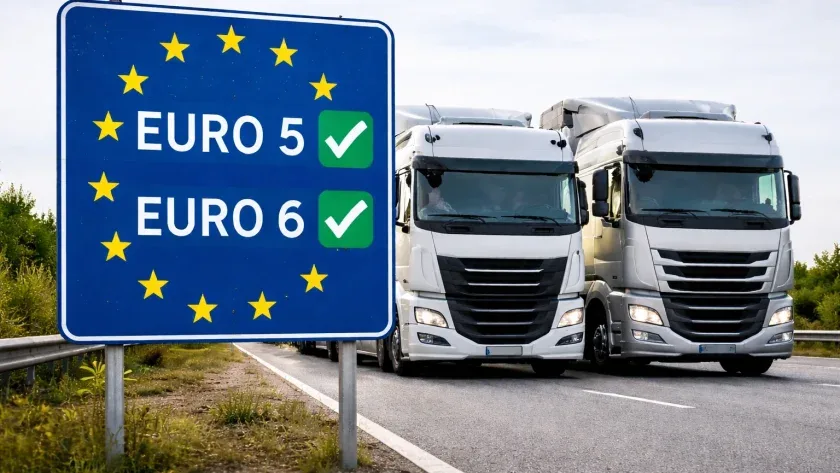
If you're already working or planning to enter the EU haulage market, meeting emission-standard requirements isn't a recommendation — it's a mandatory condition. And it's not just about paperwork: it determines whether you get the loads, how much you pay for road tolls, and ultimately whether a trip ends up profitable. So what do emission standards mean in practice, and how can you adapt to them profitably?
EU restrictions and their impact on trip economics
Under EU regulations (Regulation (EC) No 595/2009), the Euro 6 standard has applied to new trucks since 2014. Euro 5 isn't formally banned, but many countries operate Low Emission Zones — areas with restricted access for vehicles below a certain emission standard. According to the European Environment Agency (EEA), the number of such zones keeps growing. For a carrier, this translates into concrete costs. In major cities in Germany, France, Belgium, and elsewhere, vehicles below Euro 6 are either restricted from entry or pay more. For example, Germany's Toll Collect system directly factors in the emission class — the lower the compliance, the higher the toll rate.
Ukrainian carriers should be looking ahead now more than ever. The country is moving toward EU integration, so the likelihood of stricter emission-standard enforcement on the domestic market is growing. What is a requirement for Europe today may well become a mandatory norm for our own hauling tomorrow.
Euro 5 and Euro 6 on the secondary market
On the Ukrainian market, the price gap between Euro 5 and Euro 6 is significant. Euro 5 tractor units can be found from roughly $20,000–30,000, while Euro 6 units start at approximately $28,000–45,000 depending on year and condition. A difference of $5,000–10,000 is often decisive at the start. Does that make Euro 5 a bad choice? No. If your routes don't enter "strict" urban zones, it can be an economically sound option. But for long-term work in the EU and cooperation with large logistics hubs, Euro 6 looks like the more stable solution in terms of tolls and potential restrictions.
It's worth understanding: a used truck isn't necessarily a "tired" one.
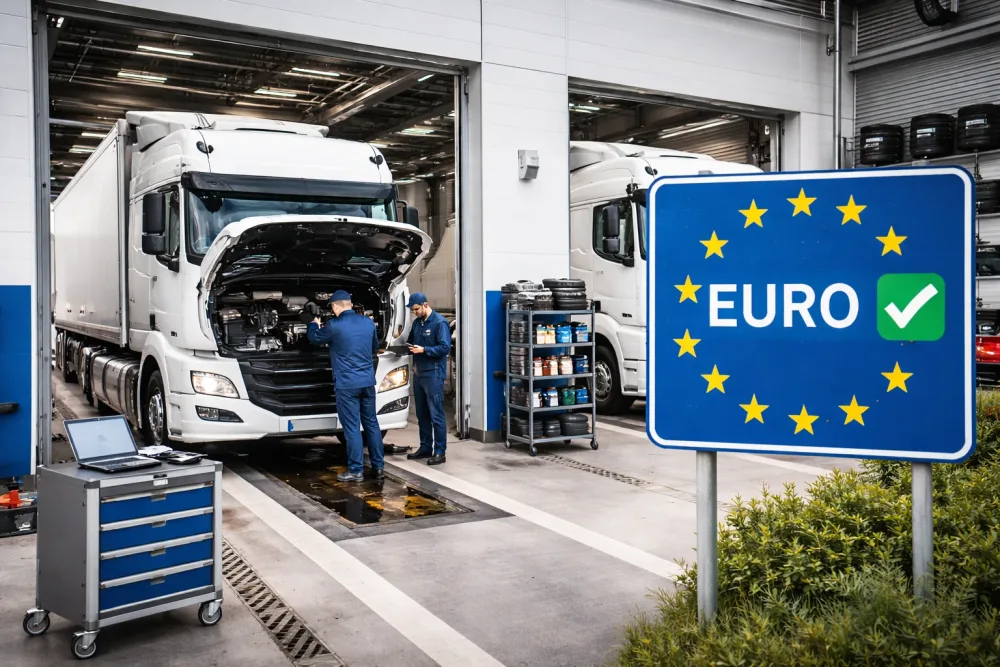
Often these are vehicles coming off leasing contracts with a transparent history. With a proper inspection, they have enough life left for several years of work without major investment. In practice, carriers increasingly choose not the "newest" option, but the "most rational" one. In 2026, the emission standard is already part of a carrier's financial model. And it's precisely the right choice that determines whether a trip generates profit rather than extra costs.
Browse our wide selection of trucks, including Euro 5 and Euro 6 emission-standard units, at tirkomis.
Related articles

How we import a tractor unit from Europe: 9 steps from selection to keys
We break down the whole deal — from finding the right unit at an EU yard and checking its history to customs clearance and registration in Rivne. How long it takes and what you actually pay for.

Semi-trailer tanker or fuel truck: what to choose
Comparing semi-trailer tankers and fuel trucks: capacity, ADR, inspection and prices. TIRkomis - free parking space and advertising for sale.

Truck 6×4: air suspension or leaf springs
Air suspension or leaf springs — which is better for a 6×4 tractor unit? We compare two Volvo FH from the TIRkomis lot and figure out which option suits heavy hauling, tipper work, construction sites, and challenging approach roads.