Which Dump Truck to Choose for Work
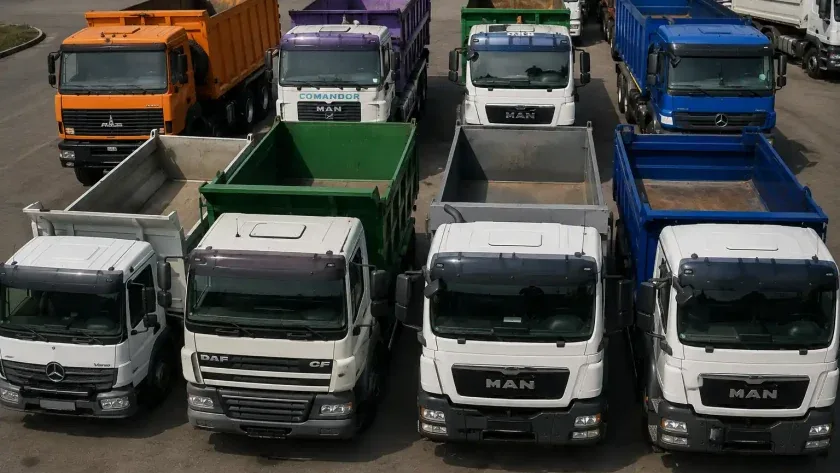
You shouldn't pick a dump truck by the rule "the bigger the body, the better." For city work, maneuverability matters most. For construction, you need a sturdy frame, hydraulics and a balance between cubic capacity and payload. For agriculture, it's body volume and sides. For gravel and wet sand, it's the permissible weight, axles and chassis, because a truck can be overloaded before the body is even full.
Our truck catalog at tirkomis includes various dump trucks: a compact Mercedes-Benz Vario, simpler MAZ models, a versatile DAF CF, heavier MAN TGA, MAN Comandor and a newer MAN TGS.
Dump truck or tipping semi-trailer: where to start choosing
A dump truck is a complete vehicle with its own chassis, engine, body and hydraulics. It's the choice when you need autonomy and maneuverability: driving onto a construction site, turning around in a yard, hauling sand or gravel on a short route, working around the city, a village, municipal or local sites.
A tipping semi-trailer follows different logic. It's considered when you already have a tractor unit or need larger volumes for longer hauls. For more detail, see the article on multi-tonne dump semi-trailers.
For city work, municipal tasks, private households, small construction sites and short hauls, a dump truck is often more practical. It doesn't need a separate tractor unit, maneuvers more easily and gets to work faster. See also "10-Tonne Truck for Work: Which One to Choose and Why".
Which dump truck format to choose for your work
You need to start with the working conditions. One dump truck can be convenient for the city but weak for daily construction work.
Compact format (3–7 m³). A compact dump truck at 3–7 m³ suits city work, municipal tasks, yards, private sector jobs, small sites and local hauling of sand, soil or gravel. Its advantage isn't tonnage — it's maneuverability. Example — Mercedes-Benz Vario 816 D.
Medium format (8–14 m³). A medium dump truck at 8–14 m³ is the most practical format for construction, local hauling, sand, soil, gravel, screenings or part of agricultural loads. In this segment, it's not just the body and hydraulics that matter, but also the chassis: frame, axles, suspension, gearbox and brakes. Examples — MAZ dump truck and DAF CF 85.410.
Heavy format (15–25 m³). A heavier dump truck at 15–25 m³ is needed when work is more intensive: larger volumes, harder access, agriculture, construction, frequent runs. Here the number of axles, drive type, axle condition, frame strength, engine power and chassis reserve all matter. Examples — MAN TGA 26.440, MAN Comandor F2000 and MAN TGS 24.460.
Once you've chosen the format, it's easier to filter out unsuitable options. If you need a vehicle for yards and municipal tasks, don't start with a heavy MAN. If you need daily gravel work, a compact Vario won't handle it.
| Work | Dump truck format | Body size guide | Catalog example |
|---|---|---|---|
| City, yards, municipal tasks | Compact dump truck | 3–7 m³ | Mercedes-Benz Vario 816 D |
| Local construction | Medium dump truck | 8–14 m³ | MAZ, DAF CF 85.410 |
| Sand, soil, gravel on short routes | Medium or heavier dump truck | 8–16 m³ | DAF CF, MAN TGA |
| Agriculture and lighter bulk loads | Dump truck with a larger body | 12–25 m³ | DAF CF, MAN TGA |
| Heavier construction and intensive work | More powerful base | 15–25+ m³ | MAN TGA, MAN Comandor, MAN TGS |
How the load affects your choice: sand, gravel, soil, grain
Cubic capacity doesn't equal payload. A 16–20 m³ body works differently with grain, soil, wet sand and gravel: a lighter load hits the volume limit faster, a heavy one hits the permissible weight, axle count and chassis condition limit first.
Gravel. For gravel, a solid floor, frame, axles, suspension and weight reserve matter. A large body can actually be a drawback here: the truck can easily be overloaded before the body is even full.
Sand. For sand, you need to look at weight capacity, side sealing, the tailgate and the lifting mechanism. Wet sand creates a completely different load than dry sand.
Soil. For soil, the body shape, floor condition, tipping angle and hydraulic cylinder performance matter, because wet soil can stick and be hard to unload.
Grain. For grain, on the other hand, cubic capacity, side height and loading convenience matter more. Here a 15–25 m³ body can be appropriate, if the gross weight and documents allow it.
Construction debris. For construction debris, a solid floor, sides and tailgate are needed, because concrete, brick and stone quickly damage a weak body.
For heavy loads, you also need to account for weight and dimension control — see "On Measures for Preserving Public Roads".
| Load | What matters most | Format to look at | Risk of a mistake |
|---|---|---|---|
| Gravel | Permissible weight, frame, axles, solid floor | 8–14 m³ or a heavier base | Overloading the truck before the body is full |
| Sand | Weight, sides, sealing, hydraulics | 8–16 m³ | Not accounting for the weight of wet sand |
| Soil | Body shape, tipping angle, floor condition | 10–18 m³ | Sticking and difficult unloading |
| Grain | Volume, side height, loading convenience | 12–25 m³ | Taking too few cubic meters for a lighter load |
| Construction debris | Floor strength, sides, tailgate | 8–16 m³ | Quickly damaging a weak body |
Body, hydraulics and chassis: what really determines a dump truck's price
For a dump truck, price isn't determined by year and make alone. What matters more is a sound body, a straight frame, working hydraulics, axles, suspension, engine and gearbox.
The body should be assessed against the load: for gravel and construction debris you need a solid floor, sides and tailgate; for grain, volume and side height; for soil, body shape and smooth unloading. A box-shaped body is more universal, while a semi-round or U-shaped body works better with bulk materials. See body examples at MEILLER rear tippers.
Hydraulics should be checked in action: the body should lift evenly, without tilting, jerking, noise or delays. Separately check the cylinder, pump, hoses, tank, valves, leaks and the PTO. If the hydraulics are worn, the truck will lose time on every unload. On tractor-unit hydraulics, see "Tractor Unit with Hydraulics: Who Needs It and How to Choose".
The chassis shows real-world use: cracks in the frame, reinforcement near the subframe, fresh paint, welding marks, uneven tire wear, axle play and sagging springs often indicate overloading. For reference, compare a modern DAF XDC/XFC and a Volvo FMX.
The engine and gearbox should be evaluated under load: low-rev torque, shifting, the clutch or automatic transmission, cooling, smoke and stability on an incline matter more than how the truck drives empty.
How to narrow your choice quickly before buying
| If you need | Look at | Don't get wrong |
|---|---|---|
| City, yards, municipal tasks | 3–7 m³ | Don't take too large a truck |
| Construction and local runs | 8–14 m³ | Don't chase cubic capacity without a weight reserve |
| Sand and gravel | Medium or heavier base | Count the permissible weight, not just volume |
| Agriculture and grain | 12–25 m³ | Look at sides, capacity and loading |
| Harsh conditions | MAN/DAF or an equivalent on a stronger chassis | Check the frame, axles, suspension, gearbox |
| Limited budget | Older MAZ/DAF/MAN | Budget for the first repair, not just the price |
Frequently Asked Questions
Which dump truck should I choose for construction?
For construction, a medium or heavier dump truck at 8–14 m³ or 8–18 m³ is usually the best fit, depending on the load. What matters isn't just cubic capacity, but also the frame, axles, suspension, gearbox, hydraulics and body condition.
What body volume is needed for sand and gravel?
For sand and gravel, it's not worth chasing a large body. A format of 8–14 or 8–16 m³ is often more practical, but with proper payload capacity, a sound frame and chassis reserve. A heavy load can overload the truck before the body is even full.
Is it worth getting a 20–25 m³ body?
Yes, if the load is lighter or more voluminous: grain, soil, some agricultural loads. For gravel, wet sand or construction debris, a 20–25 m³ body can be a risk if the chassis and permissible weight don't match the actual load.
What should I check first before putting down a deposit?
Start with the chassis and documents: frame, axles, suspension, gearbox, VIN, registration certificate, owner, gross weight. Then the body and hydraulics: floor, sides, subframe, hydraulic cylinder, pump, hoses and how evenly the body lifts.
How much does a used dump truck cost?
At tirkomis, budgets start at roughly $14,500 for a MAZ. A Mercedes-Benz Vario costs around $19,999–25,000, a DAF CF 85.410 around $20,000, a MAN TGA around $22,000, a MAN Comandor around $28,000, and a 2017 MAN TGS 24.460 around €49,000.
Related articles

Semi-trailer bag: what to do with it after purchase
How to use or convert a semi-trailer bag. Inspection, documents and prices. TIRkomis - free parking and advertising for sale.

How to choose a container chassis: 20, 40, 45
How to choose a container chassis for 20, 40, and 45-foot containers? We'll break down frame types, container locks, axle loads, compatibility with the tractor unit, and how to inspect a used chassis before buying.

Truck unit diagnostics before purchase: which faults are critical
We explain how to read a ttruckunit computer diagnostic report, which engine, transmission, EBS, AdBlue and DPF faults are critical, and when a malfunction is grounds for justified negotiation.